Research
My research focuses on biomechanics, tissue engineering, and quantitative analysis of medical devices and biomaterials.
Bioinspired Structural Heterogeneity Directs Host Remodeling and Limits Intimal Hyperplasia in Small-Diameter Vascular Grafts
Accepted for publication · Journal information coming soon
View Paper PDF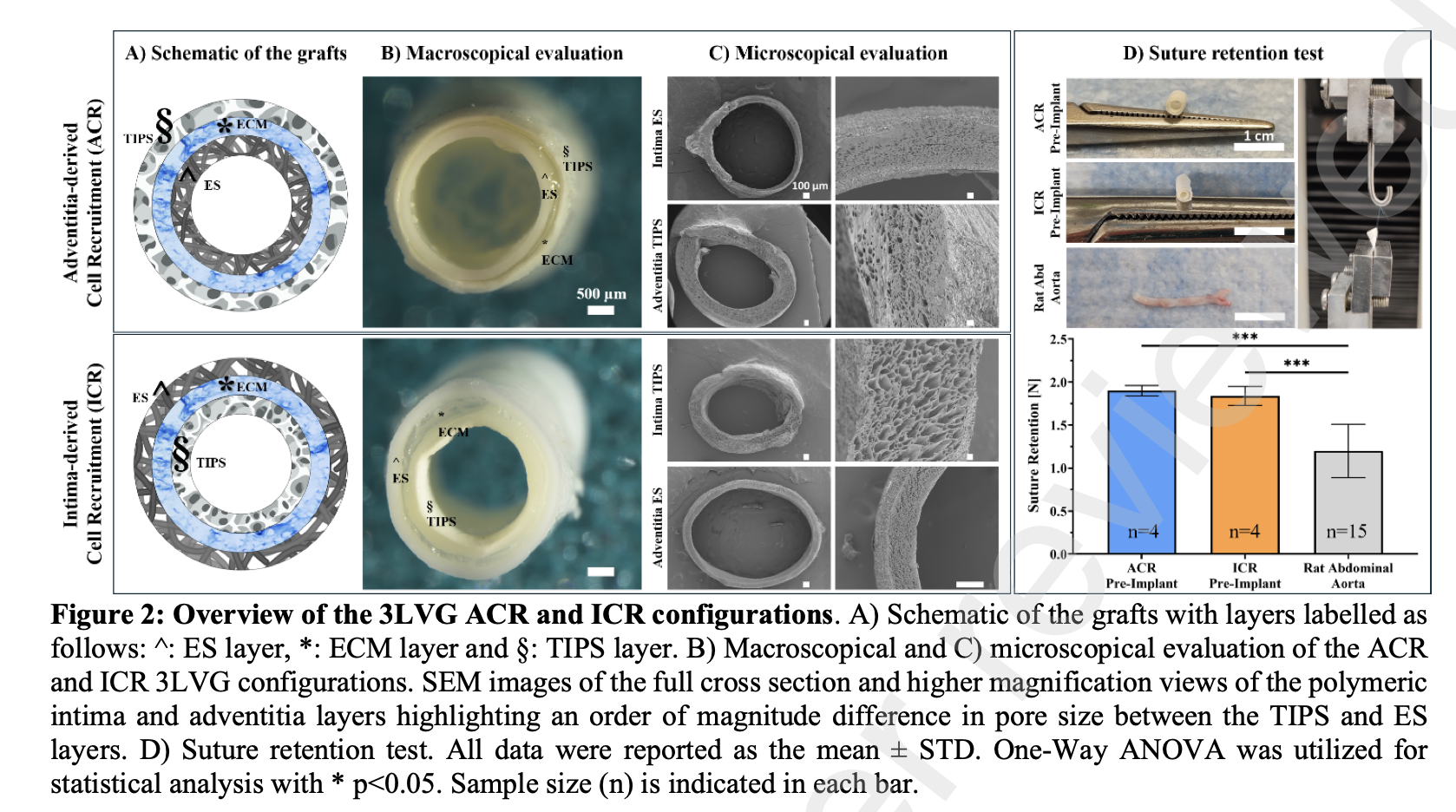
Project Overview
Small-diameter vascular grafts are used to replace damaged blood vessels, but current synthetic grafts often fail because they are susceptible to thrombosis, intimal hyperplasia, and poor long-term patency. This project developed a biomimetic three-layer vascular graft designed to recreate the layered architecture of native arteries and direct host cell infiltration during healing.
The graft combined electrospun polymers with decellularized extracellular matrix to create structural gradients that encouraged healthy tissue remodeling. When implanted in a rat abdominal aorta model, the bioinspired design demonstrated improved endothelialization, greater collagen deposition, enhanced microvascular formation, and maintained 100% patency through eight weeks.
My Contributions
I developed computational tools that enabled quantitative evaluation of both the biological remodeling and mechanical performance of the tissue-engineered vascular grafts.
- Developed and optimized custom MATLAB scripts to automate quantitative analysis of more than 2,700 histological images.
- Quantified scaffold remodeling, calcification, cell infiltration, and tissue composition from microscopy images.
- Developed MATLAB analysis tools to compare the mechanical compliance of tissue-engineered grafts with native rat vessels.
- Supported quantitative data analysis used to evaluate relationships between scaffold architecture and in vivo remodeling outcomes.
Engineering Skills
Why This Research Matters
One of the greatest challenges in tissue engineering is designing biomaterials that actively guide the body's natural healing process rather than simply replacing damaged tissue. This work demonstrates that engineering structural gradients within vascular grafts can influence how cells repopulate implanted materials, ultimately improving long-term performance.